Introduction
You buy a GH₵20 data bundle, browse social media, watch a few videos and reply to messages. Before long, your data balance has dropped considerably. Sometimes, it seems to disappear faster than you expected.
Where does all that data go? What exactly are you buying when you purchase a data bundle? And why must you pay to access the internet in the first place?
These are questions many internet users rarely stop to consider. We buy data because we need to get online, but the technology and infrastructure that make it possible remain largely invisible to us.
To understand why data gets consumed, we must first understand what it is, how the internet works and the role internet service providers play in connecting us to it.
1. First, What Exactly Is Data?
The word data can mean different things depending on the context. In everyday conversation, it often refers to facts, figures or information collected for analysis. In computing and telecommunications, however, data also refers to digital information that computers and other devices store, process and exchange.
Think about the activities you perform on your phone. When you read a news article, send a WhatsApp message, upload a photograph, watch a YouTube video or download an application, your device exchanges digital information with other systems.
That information is data.
A photograph consists of digital information representing its colours, dimensions and other image properties. A video contains information representing successive images and, usually, audio. A text message contains digital information representing the characters and other information needed to deliver it.
When you access these things over the internet, your device sends and receives data through a network.
But how much data does a particular activity consume? How do internet providers measure it? And what does it mean when your provider says you have 1 GB of data available?
To answer those questions, we need to understand how the internet works.
2. How Does the Internet Work?
The internet is a global network of interconnected computer networks. It allows devices and systems around the world to communicate and exchange information using agreed technical standards.
It is not one enormous computer owned by a single organisation. Instead, it is an interconnected system involving telecommunications companies, internet service providers, businesses, data centres, universities, governments and countless other organisations and individuals.
When you open a website on your phone, several things happen behind the scenes.
First, your phone needs to establish communication with the systems hosting that website. Your device uses networking protocols to exchange information with those systems. Domain names, such as those used for websites, are translated into network addresses that allow your device to locate the appropriate destination.
Your request then travels through the networks connecting your device to the destination server. The server processes the request and sends back the information needed to display the website.
That information might include text, images, videos, scripts and other resources.
Your browser receives and processes the information, allowing the website to appear on your screen.
All of this can happen in a fraction of a second.
The important point is that the internet works by allowing connected devices and systems to exchange digital information across interconnected networks. Your phone is not simply displaying information that magically appears on the screen. It is communicating with other systems, and that communication requires data to travel between them.
How does the information travel?
Internet communication does not generally involve sending an entire website, photograph or video as one indivisible unit.
Instead, information is transmitted using smaller units called packets. These carry portions of the information being exchanged, together with technical details that help networks deliver them to their destinations.
Routers direct packets through networks towards their destinations. Depending on the communication involved, protocols also help ensure that information is received correctly and reassembled into a usable form.
The physical means of transmission can vary. Information may travel as light signals through fibre-optic cables, electrical signals through certain types of cable, or radio signals across wireless connections.
For international communication, undersea fibre-optic cables carry enormous volumes of traffic between continents. Other terrestrial cables, network equipment and wireless systems connect devices and networks along the way.
The internet is therefore both a system of communication and a vast physical infrastructure. Although we experience it through applications and websites, those services depend on equipment, cables, radio networks and computers operating around the world.
3. Where Do Internet Service Providers Fit In?
You might now be wondering: if the internet is a global network, who connects your phone to it?
This is where internet service providers, commonly known as ISPs, come in.
An ISP provides internet access to individuals, households and organisations. Depending on its business model, it may operate the infrastructure connecting customers to the internet, purchase connectivity from other network operators, or combine both approaches.
In Ghana, familiar examples include MTN Ghana, Telecel Ghana and AT Ghana. Other providers offer services such as fibre broadband, fixed wireless connectivity and business internet solutions.
The type of connection you use determines how your device or local network reaches the provider's infrastructure.
When you use mobile data, your phone communicates with a nearby mobile network base station. That station connects into the operator's wider network, which provides a route towards internet destinations.
When you use fibre broadband at home, information travels through a fibre-optic connection to the provider's network. Your home router then distributes the connection to devices such as your phone, laptop and television.
Wi-Fi is often involved in the second scenario, but it is important to distinguish between Wi-Fi and the internet itself. Wi-Fi is a technology for connecting devices wirelessly to a local network. The internet connection is the service that allows that network to communicate with systems beyond your home.
You can have a working Wi-Fi connection without internet access, just as you can use mobile data without connecting to a Wi-Fi network.
Regardless of the access technology, the provider helps connect your devices to the wider network of networks that makes up the internet.
Why do we need ISPs?
In principle, devices can communicate over networks without every communication passing through a conventional retail ISP. However, ordinary consumers need practical, reliable ways to connect their devices to the wider internet.
Building and operating the infrastructure required to provide that access involves substantial resources.
Depending on the provider and the services it offers, these may include:
- Mobile network towers, antennas and radio equipment.
- Fibre-optic cables and associated network equipment.
- Routers, switches and other devices that direct network traffic.
- International connectivity and arrangements with other network operators.
- Data centres, network monitoring systems and technical support.
- Electricity, maintenance, security and infrastructure upgrades.
ISPs organise and operate these services, or obtain the necessary capabilities from other providers, so that customers do not have to build their own global connectivity infrastructure.
They provide a service that allows individuals and businesses to participate in the digital world.
This brings us to an important question: if the internet allows information to move between computers, why do we have to pay to use it?
4. Why Do We Pay for Internet Access?
The internet is not a single product manufactured in one place and delivered to your phone. It is a network of networks, and keeping those networks operational requires money.
The companies that provide internet access incur costs in building, maintaining and operating their infrastructure. They must also obtain connectivity, manage network capacity, pay staff and keep their services functioning.
Their customers pay for the services that make internet access possible.
When you purchase a mobile data bundle, you are paying an ISP for internet access under the terms of a particular package. You are not buying a physical quantity of the internet, nor are you purchasing the cables or network equipment themselves.
Instead, you are purchasing a service that allows your device to send and receive digital information through the provider's network, subject to the conditions of your plan.
This distinction is important because internet access and data consumption are related, but they are not the same thing.
A provider might charge you according to the quantity of data transferred, the duration of access, the speed of the connection, a subscription period or a combination of these factors.
The way customers are charged depends on the provider's commercial model and the package they choose.
To understand those differences, we need to examine what happens when a provider sells you a data bundle.
5. What Are You Actually Buying When You Buy Mobile Data?
When you purchase a mobile data bundle, your provider typically allocates a specified quantity of data to your account for use over a particular period.
For example, a bundle might provide 1 GB of data with a validity period of seven days.
The 1 GB represents your data allowance. The seven days represent the period during which the allowance is available under the package's terms.
These are two different things.
The allowance describes how much data you can use. The validity period describes how long the package remains available.
Suppose you purchase a 1 GB bundle and use 200 MB during the first day. If your provider measures usage in the usual way, approximately 800 MB remains, subject to its accounting conventions and any other applicable bundle rules.
If you continue using the internet, the remaining allowance decreases as additional data is transferred.
Once you exhaust the allowance, you may need to purchase another bundle, activate another eligible package or use a different available method of accessing the internet.
If the bundle expires before you use all the data, the unused allowance may no longer be available. What happens next depends on the provider's terms.
This is the basic idea behind a data bundle: the provider allocates a measurable allowance for internet use, and the allowance is reduced as qualifying data usage is recorded.
But why measure usage in the first place?
6. Why Is Data Measured in Kilobytes, Megabytes and Gigabytes?
Imagine an ISP charging customers according to the number of photographs they view, the number of websites they visit or the number of videos they watch.
That would be an impractical way to measure internet usage. A short video and a feature-length film are both videos, but the quantities of data needed to deliver them can differ enormously.
Likewise, two websites may contain very different amounts of information, even if they appear similar in size on your screen.
A more consistent approach is to measure the quantity of digital information transferred.
Computers measure digital information in bits and bytes.
A bit is the smallest basic unit of digital information, represented by a binary value of 0 or 1. A byte consists of eight bits.
Larger quantities of information are commonly expressed using the following units:
| Unit | Symbol | Approximate decimal equivalent |
|---|---|---|
| Kilobyte | KB | 1,000 bytes |
| Megabyte | MB | 1,000 KB |
| Gigabyte | GB | 1,000 MB |
| Terabyte | TB | 1,000 GB |
These are decimal measurements. Computers and operating systems may also use binary units, in which 1 KiB equals 1,024 bytes, 1 MiB equals 1,024 KiB, and 1 GiB equals 1,024 MiB.
This difference can occasionally explain why a device's displayed storage or usage figures do not exactly match figures calculated using decimal units.
For everyday internet bundles, however, the key point is straightforward: a gigabyte represents a much larger quantity of digital information than a megabyte.
Your ISP can measure the volume of data transferred through its network and use that measurement to administer packages that provide different allowances.
Instead of trying to determine how much internet you have consumed by counting your activities, the provider measures the quantity of data associated with those activities.
This allows the provider to offer packages with defined limits and validity periods.
It also gives customers a way to compare allowances and understand how much usage remains.
7. How Does Your Data Get Consumed?
Every time your device exchanges information over the internet, data may be transferred in one or both directions.
When you open a webpage, your device sends requests to the relevant servers and receives the information needed to display the page.
When you upload a photograph, your device sends the photograph's digital information to another system.
When you watch a video, your device receives a continuous stream of video data, along with other information needed for playback.
These activities involve different quantities of data.
Consider the following examples.
Reading a text-based webpage
Your browser requests the page and receives its text and other resources. A simple page may consume relatively little data, although images, advertisements, scripts and other elements can increase the total.
Sending a message
A short text message generally requires relatively little data. Sending photographs, videos or large documents can require considerably more.
Streaming a video
Video streaming can consume substantial amounts of data because your device must continually receive information representing the video and its audio. Higher resolution and other quality settings can increase consumption.
Downloading an application
When you download an application, your device receives the application's files. A large application or update can consume hundreds of megabytes or several gigabytes, depending on its size.
Backing up photographs
If your phone automatically uploads photographs and videos to cloud storage, those uploads consume data. The same applies to other background activities that transfer information.
The common factor is not the number of activities you perform. It is the quantity of information transferred.
A person who spends an hour reading mostly text-based pages may consume much less data than someone who spends the same hour streaming high-resolution video.
That is why the amount of time you spend online does not, by itself, tell you how much data you will consume.
Does your data get consumed when you are not actively using your phone?
It can.
Some applications transfer data in the background even when you are not actively interacting with them.
For example, your phone might synchronise email, download updates, back up photographs or refresh application content.
These activities can consume data without you opening the relevant application yourself.
However, not every reduction in a data balance necessarily indicates unexplained background activity. Different bundles may have different rules, and a provider's usage records may not match the device's displayed figures exactly.
If your data appears to be disappearing unusually quickly, check your phone's data-usage settings and compare them with your provider's records.
Understanding which applications are transferring data can help you identify where your allowance is going.
8. Is Mobile Data Really Just Airtime Measured in Gigabytes?
It is tempting to think of mobile data as a form of airtime expressed in gigabytes.
After all, both involve paying a telecommunications provider for access to a service.
However, they measure different things.
Traditional voice airtime is commonly associated with the duration of calls, although modern voice services can also be charged in other ways. Mobile data is generally measured according to the quantity of data transferred.
For a conventional voice call charged by the minute, a longer call may mean a higher charge.
For a data bundle, the important question is how much qualifying data is transferred, not simply how long the connection remains active.
You could spend several minutes reading a small webpage and consume very little data. Alternatively, you could stream a high-resolution video for those same few minutes and consume substantially more.
Both activities require time, but their data consumption differs.
A useful way to think about mobile data is as a measured allowance for transferring digital information over a mobile network.
The allowance is not physical material, and it is not literally time rented on the internet. It is a quantity of data that your provider permits you to transfer under the terms of a particular package.
The distinction matters because a bundle can have both a data limit and a validity period.
You might exhaust the data before the validity period ends. Alternatively, the validity period might expire while some allowance remains unused.
The two limits operate independently.
9. Why Do Internet Providers Offer Different Packages?
Not everyone uses the internet in the same way.
Some people primarily exchange messages, read articles and check email. Others stream videos, attend online meetings, download large files or operate businesses that depend on continuous connectivity.
Internet providers offer different packages to accommodate different usage patterns, budgets, connection types and customer needs.
The available options depend on the provider, but several common models illustrate how the system works.
Capped data bundles
A capped bundle provides a specified data allowance.
For example, a package might provide 5 GB for a particular period. Once the allowance is exhausted, the customer may need to purchase another bundle or switch to another eligible package.
This model makes the quantity of available data explicit. Customers can select an allowance based on their expected usage and budget.
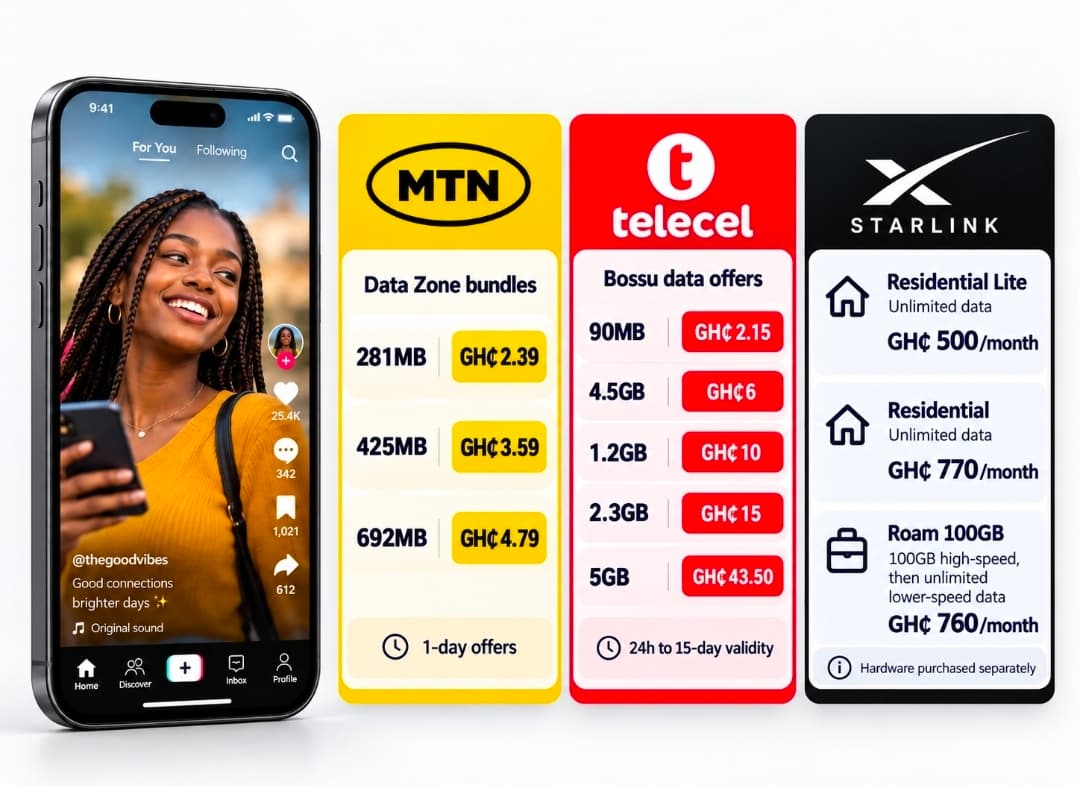
Mobile data bundles offered by providers such as MTN Ghana and Telecel Ghana are familiar examples of this approach.
Time-limited bundles
Some packages have relatively short validity periods, while others remain available for longer.
A bundle might be valid for a day, several days or a month. The exact periods and conditions vary by provider and package.
The validity period determines when the allowance can be used, rather than how much data the allowance contains.
This is why a package with a large allowance may not necessarily be the best option for someone who needs connectivity over a longer period.
Fixed broadband with a data cap
Mobile networks are not the only way to purchase internet access.
Households and businesses can also use fixed broadband services delivered through technologies such as fibre-optic cables or fixed wireless connections.
Some of these packages impose a data limit over a billing period. For example, a household might receive a monthly allowance of several hundred gigabytes.
The household can connect multiple devices to the same internet connection, and their combined usage may count towards the package's allowance.
The connection is fixed, but the data is still measured in the same fundamental units.
Unlimited data packages
Other packages are advertised as unlimited.
Under such a package, customers generally pay a subscription fee for access over a specified period rather than purchasing a fixed quantity of gigabytes that must be exhausted.
For example, MTN Ghana's published fibre guidance describes unlimited packages that provide data access at specified speeds for 30 days. This illustrates that an unlimited data allowance can still have a defined subscription period and connection speed. See the MTN Ghana Fibre Broadband Help Centre for its explanation of the service.
Unlimited does not necessarily mean unrestricted in every respect. A package may specify a connection speed or include fair-use conditions and other terms.
The important distinction is that the customer is not buying a fixed quantity of data in the same way as with a capped bundle.
Speed-based packages
Some broadband services differentiate packages according to connection speed.
Speed is commonly measured in megabits per second (Mbps), which describes how quickly data can be transferred.
A faster connection can deliver data more quickly when the network and the destination server can support that speed. It does not automatically mean that the customer has a larger data allowance.
For example, two customers might have broadband connections with different speeds but the same monthly data cap. Alternatively, they might both have unlimited allowances but receive different connection speeds.
Speed, data allowance and validity period are separate characteristics of an internet package.
Understanding the difference helps explain why two packages can have different prices even when both provide access to the internet.
10. Why Not Give Everyone Unlimited Internet?
If data is simply digital information transferred through a network, why do providers not give every customer unlimited usage?
The answer involves infrastructure, capacity, costs and commercial decisions.
Internet networks have finite capacity. A mobile network can serve many customers, but its available radio resources and supporting infrastructure must accommodate the traffic those customers generate.
Similarly, fibre broadband networks and the wider systems connecting them to the internet have capacity constraints, even when they can support very large amounts of traffic.
Providers must plan for demand, maintain their equipment and invest in infrastructure as usage grows.
A network that works well when relatively few people are using it may perform poorly if too many customers attempt to use its available capacity simultaneously.
Data allowances and package structures are among the ways providers organise their services and charge customers.
Capped packages allow a provider to define a quantity of data included in the price. Subscription-based packages can instead charge for access over a period, with the provider managing the network under the package's speed limits, fair-use policies or other conditions.
These arrangements also reflect competition, customer demand and business strategy. Not every provider will structure its packages in the same way.
It is important, however, not to assume that data caps exist solely to prevent customers from overloading the network. Providers make pricing decisions for several reasons, and the relationship between usage limits, network capacity and costs varies by service.
Likewise, an unlimited package does not mean the provider has stopped incurring costs when a customer transfers more data. The provider must still maintain the infrastructure and capacity needed to deliver the service.
The difference is in how the service is packaged, priced and managed, not in whether data is being transferred.
11. So, What Are You Really Paying For?
We can now return to the original question: what are you buying when you purchase mobile data?
You are paying for a telecommunications service that enables your device to communicate over a mobile network and access internet services under the terms of your package.
The data allowance tells you how much data you can transfer under a capped bundle. The validity period tells you how long the package remains available. The network provides the infrastructure that carries your information between your device and its destination.
These elements work together, but they represent different aspects of the service.
Your data balance is not a physical substance stored inside your phone. It is a record of the remaining allowance associated with your package.
When you browse, stream, download or upload information, your provider measures qualifying usage and adjusts the balance accordingly.
When you exhaust the allowance, you may need to purchase another package. When the validity period ends, the package may expire according to its terms.
With an unlimited package, the arrangement differs: you pay for access over a defined period, subject to the package's conditions, rather than consuming a fixed allowance of gigabytes.
In either case, you are paying for a service supported by an extensive system of networks, equipment, connectivity and operational resources.
And the same underlying principle applies beyond mobile networks. Fibre broadband and other internet services also transfer digital information. Their packages may measure usage differently, but the information travelling through the network is still data.
Conclusion: Understanding What Happens to Your Data
Mobile data can seem mysterious when a bundle disappears faster than expected. But the underlying principle is relatively straightforward.
The internet allows connected devices to exchange digital information. Internet service providers give customers access to the networks that make this communication possible. The information transferred is measured in units such as megabytes and gigabytes, and providers use those measurements to administer packages with different allowances, prices and validity periods.
A text message, a photograph, a video and a software update all involve digital information, but they can require very different quantities of data.
That is why your data balance does not decrease according to the number of minutes you spend online or the number of applications you open. It decreases according to the data usage recorded under your package's rules.
So, the next time you purchase a data bundle, remember what you are actually paying for: not a physical quantity of the internet, and not simply time spent online, but a service that allows your device to transfer digital information through a network.
Understanding that distinction is the first step towards understanding where your mobile data goes.